Two Wheel
A localizer that uses two odometry wheels and a REV Hub IMU
Automatic Tuning
The Two Wheel AutoTuner can automatically determine your encoder resolutions, encoder directions, and pod offsets.
Add the Tuner
Inside your Tuning class, add:
@Tuner
public static Procedure twoWheelTuner() {
    return new TwoWheelTuner();
}
Make sure TwoWheelTuner is imported:
import org.firstinspires.ftc.teamcode.pedro.procedures.TwoWheelTuner;Build and send the updated code to the Robot Controller.
Open AutoTune
While connected to the Robot Controller, open the following address in your browser: http://192.168.43.1:10158
Select Two Wheel Tuner.
Two Wheel Setup
Enter the HardwareMap name of the motor port that your forward pod encoder is connected to.
For example, if the forward pod encoder is plugged into the encoder port belonging
to leftFront, enter:
leftFrontNext, enter the HardwareMap name of the motor port that your strafe pod encoder is connected to.
For example:
rightRearEnter the HardwareMap name of the REV Hub IMU. This will normally be:
imuNext, select the Logo Facing Direction and USB Facing Direction that match how the Control Hub is physically mounted on your robot.
For example:
RevHubOrientationOnRobot.LogoFacingDirection.UP
RevHubOrientationOnRobot.UsbFacingDirection.BACKWARD
Then press Submit.
Important
The forward and strafe encoder names are the HardwareMap names of the motor ports that the odometry encoders are plugged into. They are not separate HardwareMap names for the odometry pods.
Encoder Resolution Setup
The tuner will ask for the exact distance that you will move the robot during the encoder resolution tests.
The default distance is:
48This value is in inches.
Enter the distance you want to use, then press Submit.
Tip
Measure the test distance as accurately as possible and keep the robot straight while moving it. You can also run the tests multiple times and compare the results.
Forward Encoder Resolution Identification
Press Continue, then push the robot straight forward by the exact distance entered during setup.
For example, if the distance was set to 48 inches, push the robot forward exactly 48 inches.
After moving the robot, stop the OpMode.
The tuner will automatically calculate the forward encoder resolution used by:
c.forwardTicksToInches.set(...);Strafe Encoder Resolution Identification
Press Continue, then push the robot to the left by the exact distance entered during setup.
After moving the robot to the left, stop the OpMode.
The tuner will automatically calculate the strafe encoder resolution used by:
c.strafeTicksToInches.set(...);Forward Direction Identification
Press Continue, then push the robot straight forward.
After moving the robot forward, stop the OpMode.
The tuner will determine whether the x pod, which is the forward pod, should
be set to FORWARD or REVERSE.
The generated configuration will contain either:
c.xPodDirection.set(Encoder.FORWARD);or:
c.xPodDirection.set(Encoder.REVERSE);Strafe Direction Identification
Press Continue, then push the robot to the left.
After moving the robot to the left, stop the OpMode.
The tuner will determine whether the y pod, which is the strafe pod, should
be set to FORWARD or REVERSE.
The generated configuration will contain either:
c.yPodDirection.set(Encoder.FORWARD);or:
c.yPodDirection.set(Encoder.REVERSE);Important
During the Strafe Direction Identification step, push the robot to the left.
In Pedro's coordinate system, forward is +X and left is +Y.
Encoder Directions
The encoder direction used by Two Wheel may not match the direction used by another localizer with the same physical odometry pod.
Pedro's Encoder also accounts for the direction of the DcMotorEx whose
encoder port is being used. Use the direction produced by the Two Wheel tuner.
Offsets Identification
Press Continue, then rotate the robot in place approximately 180 degrees.
Try to keep the center of the robot in approximately the same position while rotating.
After the robot has completed the rotation, stop the OpMode.
The tuner will automatically calculate the x and y pod offsets.
Applying the Results
Once the tuner is complete, open the Java tab.
AutoTune will generate a complete TwoWheelConfig using the values determined
during the tuning procedure.
The generated configuration includes:
- Forward encoder motor name
- Strafe encoder motor name
- IMU HardwareMap name
- Control Hub orientation
- Forward ticks to inches
- Strafe ticks to inches
- X pod direction
- Y pod direction
- X pod offset
- Y pod offset
Copy the generated configuration into the TwoWheelConfig in your
Constants.java file.
Note
Use the values generated by the tuner for your robot instead of the example values shown on this page.
Manual Offset Tuning
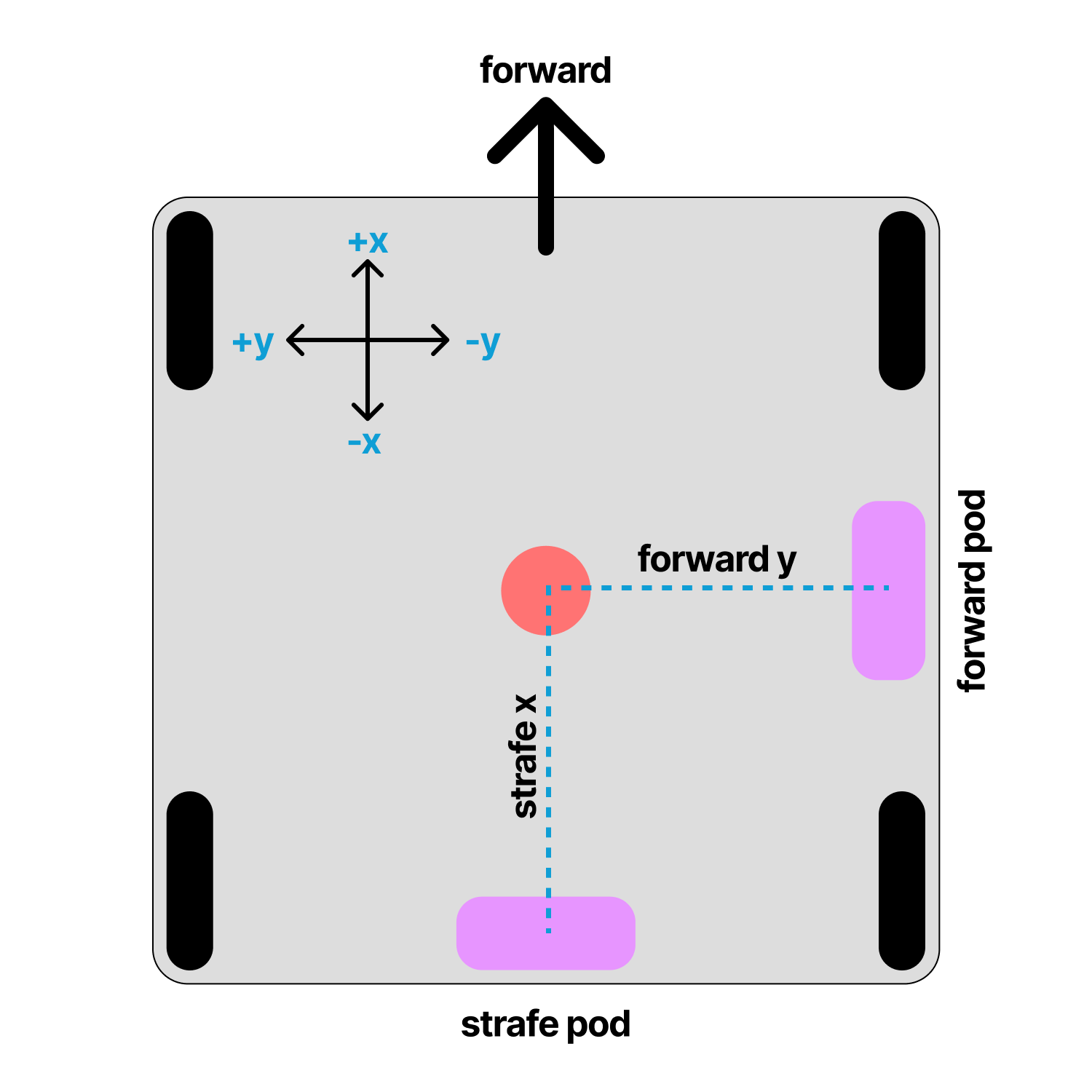
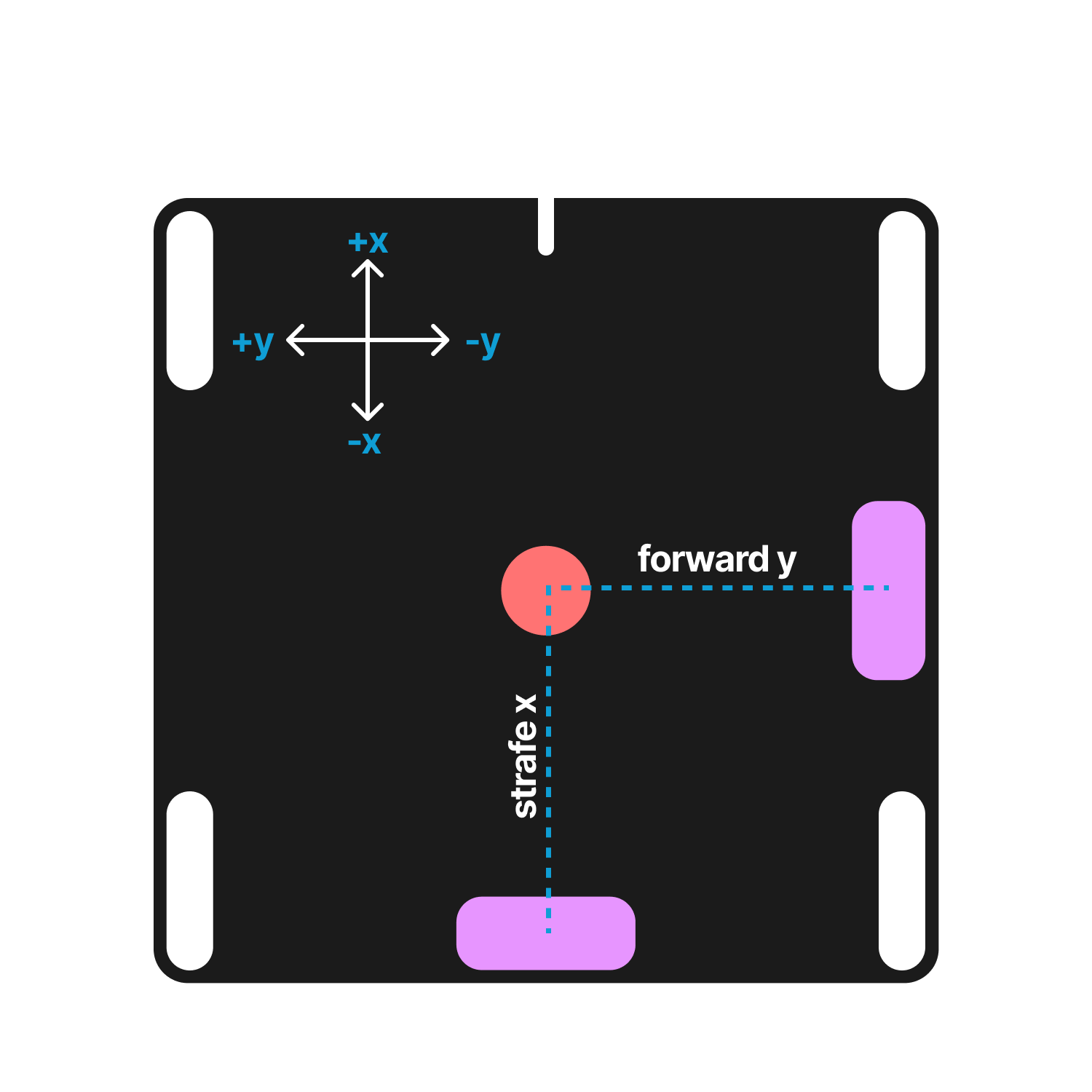
Offsets can also be found manually using the diagram below. Offsets are in inches.
Set your odometry pod offsets to define where they are relative to your robot's center of rotation.
Troubleshooting
If you have any problems, see the troubleshooting page.
Testing the Localizer
Once you have completed the tuning steps, you can test your localizer as described on the localization page.
Congratulations on successfully tuning your localizer!
Last updated on